Christina Brinkmann
Christina Brinkmann
Home
Research
Discussions
CV
Working Papers
Do Firms Hedge Human Capital?
Firms may employ more workers than currently needed. Expected excess labor capacity (which we call precautionary labor) lets them meet uncertain higher demand but, through its committed wage bill, raises financial-distress risk. We measure precautionary labor from German short-time-work records during eased-access episodes, when otherwise-hidden idle labor becomes observable, and find that among export-oriented SMEs, those with more precautionary labor hedge their foreign-exchange risk more.
Christina Brinkmann
,
Stefanie Wolter
PDF
Short-Time Work Extensions
Revise and Resubmit, Journal of Political Economy
We study a key policy lever of the short-time work (STW) scheme—extensions in the potential benefit duration (PBD)—using novel German administrative data from 2009 until 2021. Our research design, which exploits a 2012 reform that unexpectedly doubled the PBD, reveals that STW extensions in Germany did not significantly improve short- or long-term employment outcomes but points towards downward wage flexibility preventing layoffs.
Christina Brinkmann
,
Simon Jäger
,
Moritz Kuhn
,
Farzad Saidi
,
Stefanie Wolter
PDF
Differences in Default Risks and Competition in Insurance Markets
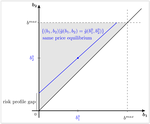
The paper studies incentives for insurance sellers to ensure solvency when insurer default risk is a quality dimension of the insurance product. In a basic insurance model, I introduce insurer default risk as a quality dimension, resulting in vertical product differentiation. I show that market discipline in the choice of default risks emerges, and discuss the result in the context of over-the-counter derivatives markets.
Christina Brinkmann
PDF
Cite
×